

Common Auto Transport Documents Explained: BOL, Title, Registration, and ID
What if transporting your car could be as stress-free as taking it for a short drive? There is a common concern about giving up a valuable possession, especially when dealing with paperwork. Jargon such as “Bill of Lading” may seem intimidating, and you might wonder whether you need to bring your title or other documents.
At Pre-Owned Auto Logistics, we make everything uncomplicated. We walk you through each required document type, explain why it is essential, and handle it all. It is a smooth, fast, and simple process with us; thus, you can concentrate on your trip, rather than the paperwork.
What Documents Do You Need to Ship a Car?
Before getting into the nitty-gritty, how about a brief and comforting overview? Essentially, for almost all standard, door-to-door car shipments within the US, you only need to have a couple of key items at hand. The rest are either “just in case” documents or intended solely for specific situations.

These are the few things you should prepare:
- Bill of lading (BOL): The most important document that serves as your receipt and contract. This is what you get from the driver.
- Vehicle title: Occasionally needed, but not for the majority of moves. Vehicle Registration: Sometimes requested, but usually not.
- Driver’s License or Government ID: The most crucial thing for identity verification.
Besides these, there are some optional documents that you might need if you happen to be in a special case:
- Loan or lease authorisation from your lender.
- Power of Attorney if someone else will sign for you.
- Proof of insurance (hardly ever required by the carrier).
- Specific auction paperwork (for Copart, IAAI, etc.).
The most important thing to keep in mind is that you are not handling it alone. The PAL team will be there with you from your very first quote through to your caris delivery, guiding you at every step and telling you precisely what you need for your particular shipment. No guessing and no unexpected things.
Bill of Lading (BOL): The Most Important Document in Car Shipping
The one term you should recall from this entire guide is the Bill of Lading (BOL). It’s not just another piece of paper; rather, it is the single most essential document in the whole auto transport process. You can think of it as the golden ticket, the official record, and your main piece of protection all combined into one.
What is a Bill of Lading?
The Bill of Lading is an official document that holds three main functions:
- A receipt is proof that the carrier (the trucking company) has the vehicle in its possession.
- A condition report documents the car’s condition at the time it is loaded onto the trailer.
- A contract: It is the agreed-upon terms of transportation, including the pickup/delivery locations and the carrier’s obligations.
For instance, after the driver arrives to pick up the car, he will check it with you. Together, you will mark on the BOL any damage found before (for example, a dent, a scratch, or a chip in the windshield), and both parties will sign it. The driver will have a copy, and you will, too. When the delivery is complete, the same check will take place, the condition will be recorded, and the BOL will be signed to confirm receipt of the vehicle. This is the “before and after” picture and, therefore, your key to a smooth transaction.
What information does a BOL include?
The typical BOL is filled with important and necessary details that leave no room for ambiguity in the record. In other words, the following are things that you are most likely to find there:
- Parties involved: Your name/address (the shipper) and the carrier’s details.
- Vehicle information: The first things are year, make, model, and most importantly, the Vehicle Identification Number (VIN).
- Condition notes: Car diagram where you could point out the damages more precisely, along with the written notes (for instance, “scratch on rear bumper, 2 inches long”).
- Mileage: You might as well write down the odometer reading at the time of pickup.
- Route details: The addresses of where the goods are picked up and where they are delivered.
- Carrier terms: The legal language that explains the carrier’s accountability.
- Signatures: Signing areas for the shipper and the carrier driver performance at both pickup and delivery.
Why the BOL protects you
Generally, this is a protective weapon. When you go on to describe the state of your vehicle in detail, you automatically create a record that cannot be disputed. Suppose a new scratch is found at delivery that is not in the original BOL. This recorded history is the starting point for insurance claims or dispute resolution. When there is no correctly filled-out BOL, it becomes a “he said, she said” case, which is quite a hassle.
At PAL, we take the difficulty out of the BOL process. Depending on your route and carrier, you may receive a traditional paper BOL or a convenient digital version via email or text. Our people make sure you know how to complete it and what to check, so you can easily accomplish this indispensable 5-minute step in your work.
Do You Need A Title To Ship A Car?
No question causes more anxiety than this one. As a rule, people panic, imagining they have to hand in their pink slip to a stranger. Let’s get it straight right away.
Title not required for standard domestic shipping.
In most cases of regular car shipping within the United States, the vehicle’s physical title is not required. The carrier is delivering your asset from Point A to Point B; they are not assuming ownership. Hence, there is no need for a standard transport to be accompanied by proof of ownership, such as a title.
It is particularly valid for cases such as:
- Homeowners who send their car ahead to their winter residence.
- People who are moving to another city because of a new job.
- Students are sending a vehicle to the new location.
- A dealer shipping a newly purchased car directly to a buyer.
In these situations, your identity (by your driver’s license) and the vehicle’s identity (by the VIN) are enough. The carrier’s first and foremost concern is the release of the car by the right person.
When a title might be required
However, there are different instances in which a title (or title-related documents) is required:
- International shipping: Customs officials almost always require a title as proof of ownership and legality when crossing borders (e.g., to Canada or overseas).
- Brand, unregistered vehicles: If you have a newly purchased car that is not registered yet, you may be asked for the Manufacturer’s Certificate of Origin (MCO) or a title application.
- Auction purchases: Some auction yards (like Copart or IAAI) have strict rules and will not release the vehicle without specific title release paperwork or an invoice proving your purchase.
Experience is what helps in such cases. At PreOwned Auto Logistics, we are constantly working with dealer and auction shipments. We are familiar with the exact documents these places require and will inform you in advance of what you need to bring, so you don’t end up unable to enter due to gate delays.
Do You Need Vehicle Registration to Ship Your Car?
As with the question in the title, the need for registration is a factor that often causes unnecessary stress. The answer is delightfully simple for the majority of you.
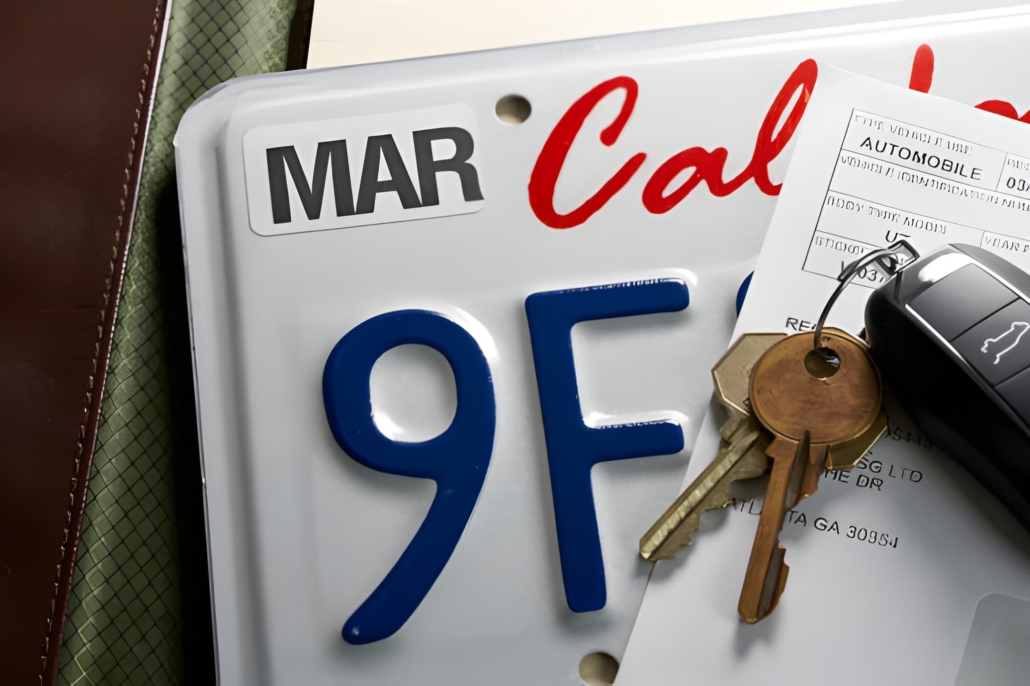
In most cases, no
Usually, your vehicle’s current registration is not required when shipping your car. The carrier is concerned with the actual vehicle and the person authorised to release it, not with the state registration. If the car is yours, the VIN matches, and the vehicle can be legally transported (e.g., it is not a stolen car), then you are, in general, safe.
Where registration may be required
There are instances where a carrier might require you to show the registration:
- Crossing state lines: Some states set stricter rules for vehicle movement. So, a registration can be an additional proof that the VIN is yours, particularly when the address on your ID does not match the pickup location.
- Military base access: Transport to or from a military base may require additional documentation for security clearance. Together with your military ID and base access forms, the registration might be one of the documents.
- Exceptional ownership cases: Should you be in a situation where you can’t provide a title for your car (e.g., a very old vehicle or an inherited one), a registration carried out in your name will go a long way in confirming the right to ship.
- The PAL advantage: We are aware of the different rules across states and destinations. Thus, if you are sending a package to a military base, a security auction yard, or a state with strict documentation laws, we will let you know in advance whether registration is required. No last-minute runs.
ID Requirements for Auto Transport
This is a non-negotiable requirement that applies to everyone. You will be required to present an identification document at the time your vehicle is being handed over.
A government-issued ID
The driver who will be picking up your car has to see the person who gives the vehicle and confirm and verify their identity. A valid, official government-issued photo ID is the usual standard. This practically means that your:
- Driver’s License (the most common)
- State identification card
- In rare cases, Passport can be used.
Ensure that your ID is still valid and has not expired. Keep it handy when the driver is coming.
Why is ID important
Everything boils down to security and liability. The carrier has to know for sure that they are handing over the vehicle to the right person, the owner or someone the owner has authorised. This stops fraud and ensures that cars are not shipped, either intentionally or, even worse, unscrupulously, without the owners’ consent. Although it is a fundamental step, it remains essential and ensures the safety of all the people involved.
Optional Documents (Sometimes Needed)
Let’s discuss the “optional” documents next. Most likely, you will not be required to produce any of these documents, but it is still handy to know about them in case you need one.
1. Insurance documents
- Carrier insurance: All carriers must have cargo insurance in accordance with the law. Therefore, PAL works only with insured airlines, and we keep you informed of their insurance provisions for your records.
- Your personal insurance: There are hardly any situations when your personal car insurance should be presented to the carrier. Your vehicle will be under the carrier’s insurance during transport. Nevertheless, it never hurts to have your own insurance in force, as it most often covers the car once it has been unloaded and is at the new location.
2. Loan or lease authorisation
If your car is financed or under a lease agreement, the bank or leasing company is a lienholder on the title; they are partial owners of your vehicle by legal definition. Though it rarely hampers the transportation of shipped cars across state lines, some lien holders have set policies that require notifying them or obtaining permission letters from them first. Checking your loan agreement or leasing contract, or even giving your lender a quick call, will ensure everything runs smoothly and you face no issues.
3. Power of attorney
The use of a power of attorney (POA) arises in a case where you are not able to be present at either the pickup or delivery locations. Suppose, for instance, that you are relocating before your car, and a friend or relative will hand the vehicle over to the driver; then a limited POA can empower that person to sign the BOL on your behalf. This legally transfers your authority to the carrier and gives the airline unambiguous authority to interact with the person you authorised.
4. Auction paperwork
If you purchase a vehicle through an online auction like Copart, IAAI, or Manheim, the pickup steps are well defined. You need the proper paperwork to allow the yard to release your vehicle to the carrier. Commonly, it comprises the following items:
- The invoice with full payment is indicated.
- A copy of your ID card.
- A signed (and sometimes notarized) bill of lading.
- Any gate passes required by a specific facility.
This is something PAL really excels at. We execute auction freight daily. We will equip you with accurate, understandable guidance and the exact documents that you need to send to us so the pickup can be staged flawlessly.
How PreOwned Auto Logistics Simplifies the Process
You have just gone through all the possible auto transport documents. It may still seem as if there are too many things to be in charge of, which is precisely why you need a professional broker like us. Our benefit is not limited to finding a truck for you.
We, therefore, become your documentation concierge. The staff we have are very experienced and have handled a wide range of shipments, whether a sedan for a retiree or several vehicles for a big company. As a result, we not only know the exact papers your individual case requires but also which ones are not needed. We spare you the unnecessary troubles.
We take the burden off your shoulders by:
- Expert guidance: Even before you call us, our team members know which questions to ask to determine which documents are necessary for your shipment. We are familiar with dealer, auction, military, and snowbird processes and can handle any of them.
- No paperwork block: We won’t need you to provide the documents you already have or those that are redundant. Requests are limited to what is necessary to be efficient.
- Digital-first convenience: We use email, text, and customer portals to send and receive the documents needed, providing a quick, environmentally friendly process.
- Pre-pickup clarity: We communicate in writing and help you get ready for the driver’s arrival by providing detailed information about what will happen on the day we pick up your package.
- Top-rated support: Our team is ready to help you and will always be here with answers to any questions that might arise at the last minute. There is never any doubt about which step comes next after support contact.
PAL makes the process less complicated and more organised, so documents become milestones on a smooth journey together rather than obstacles.
Quick Document Checklist for Car Shipping
Let’s simplify everything into a straightforward, practical checklist. Consider this your cheat sheet while you are getting ready for pickup day:
- Driver’s License or Government ID, bring to pickup
- Vehicle Keys: All copies without keychains
- Title Access: Know its location, keep it secure, rarely needed
- Loan or Lease Approval: If applicable, confirm with the lender
- Auction Paperwork: If shipping from Copart or IAAI, send ahead
- Signed BOL Review carefully at pickup and delivery
- Personal Belongings: Remove all not covered by insurance
FAQ: Auto Transport Documents You Need
Do I need my car title to ship a car?
For most standard domestic shipments within the U.S., no, you do not. It is required only for international shipping, for some new/unregistered vehicles, and for certain auction releases.
Can I ship a car that’s not registered?
Yes, often you can. The vehicle does not need to have current registration plates to be transported. However, you must be able to prove you own it (usually with a title), and it must be in a condition that allows it to be safely loaded and unloaded.
What is a Bill of Lading, and why is it important?
The Bill of Lading (BOL) is your receipt, condition report, and shipping contract. It’s crucial because it legally documents the condition of your car before and after transport, protecting you in the event of any damage disputes.
Can someone else sign the BOL for me?
Yes, but they need authorization. The best way is to provide them with a limited Power of Attorney (POA) document. Always inform your broker (like PAL) in advance if someone else will be signing.
Do shipping companies require insurance documents?
They require proof of their own cargo insurance, which PAL provides. They do not typically ask to see your personal auto insurance documents.
Do I need ID when the driver picks up my car?
Yes, absolutely. A valid, government-issued photo ID (such as a driver’s license) is required for the driver to verify your identity before taking possession of your vehicle.
What documents are needed for military car shipping?
This can vary by base. Typically, you’ll need your driver’s license, military ID, vehicle registration, and possibly a copy of your orders. The carrier will also need base access forms, which PAL helps coordinate. We have extensive experience with PCS moves and know base requirements.